Tuesday, 11 June 2013

ATTACKS AND BLASTS IN KABUL

Today a car bomb exploded in Kabul killing at least 16 people and injuring more than 40 others. The target of the attack was the Supreme Court. The attacker drove a car full of explosives into buses which were transporting Supreme Court staff and judges. The Taliban have taken responsibility for the blast. The Supreme Court is located near the US embassy and NATO headquarters. 

This comes following the attack on the capital's airport and the discovery of the bodies of 2 boys. On Monday, 10th June, 7 Taliban insurgents targeted the Kabul airport. All 7 attackers were killed and 3 policemen and 15 civilians were injured.

On the same day, in the southern Afghan province of Kandahar, the bodies of 2 boys were discovered. The Taliban, beheaded 2 boys for allegedly spying. The boys aged 10 and 16 were scavenging for food near police headquarters when they were abducted on 9th June.The boys also accepted food handouts from police too. It is thought that they wee suspected of working for the police by the Taliban. However, the Taliban have denied responsibility . According to several sources, the children were beheaded as a warning to villagers to not cooperate with the Afghan government. 

In 2012, the Taliban were accused of beheading a 12 year old boy and 7 year old girl. The Taliban have denied responsibility in both cases.

The NCF condemns these attacks and all types of violence against the Afghan government and people. Security is a serious concern in Afghanistan.  Huge amounts of humanitarian aid goes into Afghanistan and there is a general assumption that the more aid is spent, the more security will improve. What is clear that aid is effective in helping development needs but it is evident that this isn't effective in addressing security concerns. 


Monday, 10 June 2013

LANDAYS: POETRY OF AFGHAN WOMEN

Interesting article about landays and women in Afghanistan


The teenage poet who uttered this folk poem called herself Rahila Muska. She lived in Helmand, a Taliban stronghold and one of the most restive of Afghanistan’s thirty-four provinces since the U.S. invasion began on October 7, 2001. Muska, like many young and rural Afghan women, wasn’t allowed to leave her home. Fearing that she’d be kidnapped or raped by warlords, her father pulled her out of school after the fifth grade. Poetry, which she learned from other women and on the radio, became her only form of education.


Poems and Pictures of Contemporary Afghanistan

by Eliza Griswold

Tuesday, 16 April 2013

138 Comments so far!

Afghan National Army soldiers graduating. A Commons committee has predicted civil war
when the west pulls out next year. Photograph: Xinhua Press/Corbis

writing in The Guardian says: When I returned to Kabul in January and asked an American journalist I'd known in 2001 his view of the situation, he said: "When you look at the facts on the ground, it is hard to believe that civil war is not inevitable."

The facts on the ground include the militias the west has set up in the countryside in a desperate attempt to shore up the barely legitimate Karzai regime. Sadly, these militias, plus the many Afghan private security companies, have contributed to a proliferation of armed groups that will be roaming the country after 2014.

FOR FULL ARTICLE CLICK HERE

Wednesday, 27 February 2013

AFGHANISTAN CIVILIAN CASUALTIES DOWN


For the first time in 6 years, casualty figures in Afghanistan have declined. According to the UN Assistance Mission in Afghanistan (UNAMA), there has been a 12% decrease in civilian casualties with a slight increase in injuries.

This is due to a harsh winter which saw fewer suicide bomb attacks, fighting on the ground and air operations.  However, this is rather misleading and does not mean that threats against Afghan men, women and children have diminished. Civilians continue to face threats, intimidation and interference from armed militant groups.

Jan Kubis, the UN special representative in Afghanistan, claimed that seeing the recent decrease in casualty numbers granted temporary relief but the “human cost of the conflict remains unacceptable.”  He further added that it is mainly women and children who continue to suffer the most from the effects of armed conflict while engaging in everyday activities with an increase of 20% in those killed and injured. 

In 2012, 81% of civilian casualties were a result of improvised explosive devices laid by insurgents and 8% from operations by pro-government forces. The report also states that targeted killings by militants increased by 108%.

Although the number of Afghans killed by NATO-led forces dropped by 40%, a recent UN report stated that hundreds of Afghan children have been killed by US air strikes over the last 4 years. The numbers especially doubled between 2010-2011 due to the “lack of precautionary measures and use of indiscriminate force.” This led President Hamid Karzai to ban the Afghan military from requesting aerial support from NATO-led forces.

The recent figures generated mixed feelings among the Afghans who were more concerned about security with some even claiming that the UN was biased in its research. For now, it seems that the Taliban have shifted their focus to targeting foreign troops. 

To date 14, 728 Afghans have lost their lives. 

Thursday, 9 August 2012

Justice for Women

Some stories have come to my attention in the past couple of weeks. The first was the news that a woman was executed by the Taliban over claims that she had committed adultery.

The other was about an Afghan girl, Walija, who was being divorced by her unscrupulous husband with disastrous consequences. She was beaten by both him and his father after refusing to sign divorce papers before she receives money that is owed to her. She does have relatives in Australia and, they are filing for asylum status.

She is in the process of getting her citizenship.

It is difficult to believe that these two cases are both taking place in 2012. Stoning a women for adultery and beating another for questioning the divorce process! The sad reality is that the 'adulterous' woman may have been innocent, but we shall never know as there is no justice system that is equipped to deal with family issues. Let us hope that there may at least be a future for Walija in Australia.

Friday, 3 August 2012

The Taliban are not the only issue of importance


- 03/08/12

Whilst it is easy, from a Western perspective, to concentrate almost exclusively on the issue of the Taliban, other factors will have a strong effect on whether Afghanistan can become peaceful and stable after the exit of coalition troops. 

New York Times graphic from 2009 showing areas of Taliban control
This week, Russian President Vladimir Putin spoke on Afghanistan. He said that NATO should finish the job they started, as he critiqued the plan to pull out coalition troops by 2014. Russia is concerned that a premature exit by coalition troops will have a destabilising effect on central Asia, something that the Russians do not want on their southern border. This is not an issue which is often discussed in the Western media, which is more interested in covering stories about Helmand and Kandahar, areas in the south of the country where the Taliban are most active. The north of Afghanistan is normally characterised as being far less problematic because the Taliban have less influence there (as this graphic from the New York Times shows ). 
Indeed, some areas of the north never fell under Taliban control during the civil war and were held by the Northern Alliance (an umbrella term used after 1996 for groups resisting the Taliban and led by leaders such as Dostum and Massoud).
This lack of focus on the northern areas could be dangerous, because although the Taliban pose much less of a threat there, other problems in the region threaten to cause serious damage after the coalition leave. Tajikistan has already, this week, suffered the worst violence since the end of their civil war in 1997, as the government launched a military operation against insurgents. This is the direct result of the flow of opium coming from Afghanistan, and destined for consumers in Russia and Europe, which fuels and funds violence in Tajikistan. There is a serious concern that this violence could affect Afghanistan as well. A chief of police near the border between the two countries has recently been arrested on suspicion of helping those fighting against the government in Tajikistan. The worry is that the exit of coalition troops will allow for more corruption and the encouragement of the drugs trade by people in power in Afghanistan, undermining stability and development.
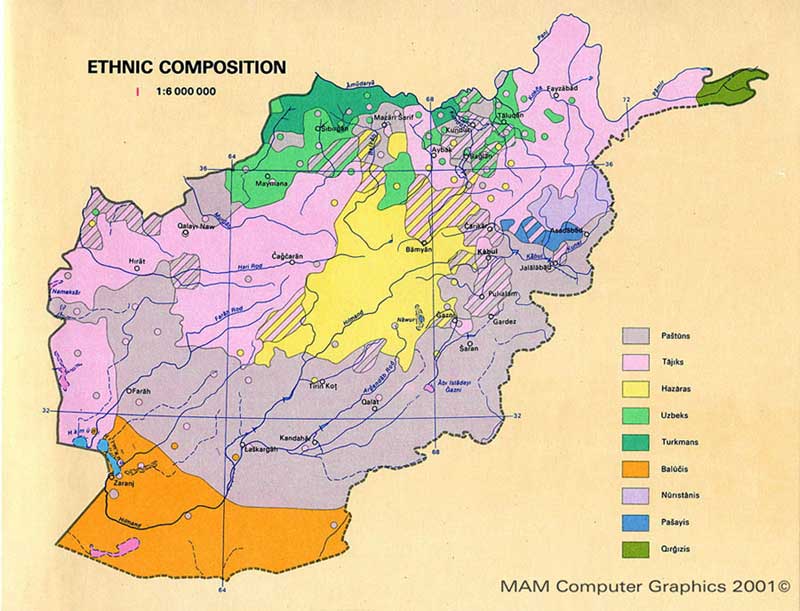
Afghanistan has a large number of diverse ethnic groups
Another problem that could return to the surface is ethnic discrimination. Northern Afghanistan is home to a wide variety of ethnic groups, including Uzbeks, Turkmens, Tajiks, Hazaras and Pashtuns. As coalition troops leave, there could be increased scope for ethnic disputes, especially if they are fuelled by the relevant neighbouring countries, which so often get involved in Afghanistan’s internal affairs (Uzebekistan has close ties to the Uzbeks, the Iranians support the Hazaras etc.) The Minority Rights Group International already reports increasing ethnic tensions between Hazaras and the nomadic Kuchis travelling over their land. Relations between Pashtuns and the other ethnicities in the north have often been extremely difficult. Massacres which occurred during the Afghan Civil War (such as the killing of Hazaras in Mazar e Sharif by Taliban forces) are not easily forgotten. There have been reports since the American invasion of ethnic discrimination and violence. In Ignatieff’s book ‘Empire Lite’, he highlights how often in Afghanistan, disputes between Afghans are resolved because of the American man sitting in the corner of the room. Everyone knows that if they violate an agreement or go back on their word that American man can call in the vast airpower of the United States as a punishment. The problem is that when the Americans leave, what will ensure that violence and discrimination between different groups in Afghanistan does not re-emerge?