Thursday, 30 May 2013


Tuesday, 16 April 2013
138 Comments so far!
 |
| Afghan National Army soldiers graduating. A Commons committee has predicted civil war when the west pulls out next year. Photograph: Xinhua Press/Corbis |
Lucy Morgan Edwards writing in The Guardian says: When I returned to Kabul in January and asked an American journalist I'd known in 2001 his view of the situation, he said: "When you look at the facts on the ground, it is hard to believe that civil war is not inevitable."
The facts on the ground include the militias the west has set up in the countryside in a desperate attempt to shore up the barely legitimate Karzai regime. Sadly, these militias, plus the many Afghan private security companies, have contributed to a proliferation of armed groups that will be roaming the country after 2014.
FOR FULL ARTICLE CLICK HERE
Wednesday, 27 February 2013
AFGHANISTAN CIVILIAN CASUALTIES DOWN
For the first time in 6 years, casualty figures in
Afghanistan have declined. According to the UN Assistance Mission in
Afghanistan (UNAMA), there has been a 12% decrease in civilian casualties with
a slight increase in injuries.
This is due to a harsh winter which saw fewer suicide bomb
attacks, fighting on the ground and air operations. However, this is rather misleading and does
not mean that threats against Afghan men, women and children have diminished.
Civilians continue to face threats, intimidation and interference from armed
militant groups.
Jan Kubis, the UN special representative in Afghanistan, claimed
that seeing the recent decrease in casualty numbers granted temporary relief
but the “human cost of the conflict remains unacceptable.” He further added that it is mainly women and
children who continue to suffer the most from the effects of armed conflict
while engaging in everyday activities with an increase of 20% in those killed
and injured.
In 2012, 81% of civilian casualties were a result of
improvised explosive devices laid by insurgents and 8% from operations by
pro-government forces. The report also states that targeted killings by
militants increased by 108%.
Although the number of Afghans killed by NATO-led forces dropped
by 40%, a recent UN report stated that hundreds of Afghan
children have been killed by US air strikes over the last 4 years. The numbers
especially doubled between 2010-2011 due to the “lack of precautionary measures
and use of indiscriminate force.” This led President Hamid Karzai to ban the
Afghan military from requesting aerial support from NATO-led forces.
The recent figures generated mixed feelings among the
Afghans who were more concerned about security with some even claiming that the
UN was biased in its research. For now, it seems that the Taliban have shifted
their focus to targeting foreign troops.
To date 14, 728 Afghans have lost
their lives.
Thursday, 9 August 2012
Justice for Women
Some stories have come to my attention in the past couple of weeks. The first was the news that a woman was executed by the Taliban over claims that she had committed adultery.
The other was about an Afghan girl, Walija, who was being divorced by her unscrupulous husband with disastrous consequences. She was beaten by both him and his father after refusing to sign divorce papers before she receives money that is owed to her. She does have relatives in Australia and, they are filing for asylum status.
She is in the process of getting her citizenship.
It is difficult to believe that these two cases are both taking place in 2012. Stoning a women for adultery and beating another for questioning the divorce process! The sad reality is that the 'adulterous' woman may have been innocent, but we shall never know as there is no justice system that is equipped to deal with family issues. Let us hope that there may at least be a future for Walija in Australia.
The other was about an Afghan girl, Walija, who was being divorced by her unscrupulous husband with disastrous consequences. She was beaten by both him and his father after refusing to sign divorce papers before she receives money that is owed to her. She does have relatives in Australia and, they are filing for asylum status.
She is in the process of getting her citizenship.
It is difficult to believe that these two cases are both taking place in 2012. Stoning a women for adultery and beating another for questioning the divorce process! The sad reality is that the 'adulterous' woman may have been innocent, but we shall never know as there is no justice system that is equipped to deal with family issues. Let us hope that there may at least be a future for Walija in Australia.
Friday, 3 August 2012
The Taliban are not the only issue of importance
- 03/08/12
Whilst it is easy, from a Western perspective, to concentrate almost exclusively on the issue of the Taliban, other factors will have a strong effect on whether Afghanistan can become peaceful and stable after the exit of coalition troops.
 |
| New York Times graphic from 2009 showing areas of Taliban control |
This week, Russian President Vladimir Putin spoke
on Afghanistan. He said that NATO should finish the job they started, as he
critiqued the plan to pull out coalition troops by 2014. Russia is concerned
that a premature exit by coalition troops will have a destabilising effect on
central Asia, something that the Russians do not want on their southern border.
This is not an issue which is often discussed in the Western media, which is more
interested in covering stories about Helmand and Kandahar, areas in the south
of the country where the Taliban are most active. The north of Afghanistan is
normally characterised as being far less problematic because the Taliban have
less influence there (as
this graphic from the New York Times shows ).
Indeed, some areas of
the north never fell under Taliban control during the civil war and were held by
the Northern Alliance (an umbrella term used after 1996 for groups resisting
the Taliban and led by leaders such as Dostum and Massoud).
This lack of focus on the northern areas could be dangerous,
because although the Taliban pose much less of a threat there, other problems
in the region threaten to cause serious damage after the coalition leave.
Tajikistan has already, this week, suffered
the worst violence since the end of their civil war in 1997, as the government
launched a military operation against insurgents. This is the direct result of
the flow of opium coming from Afghanistan, and destined for consumers in Russia
and Europe, which fuels and funds violence in Tajikistan. There is a serious
concern that this violence could affect Afghanistan as well. A chief of police
near the border between the two countries has
recently been arrested on suspicion of helping those fighting against the
government in Tajikistan. The worry is that the exit of coalition troops will
allow for more corruption and the encouragement of the drugs trade by people in
power in Afghanistan, undermining stability and development.
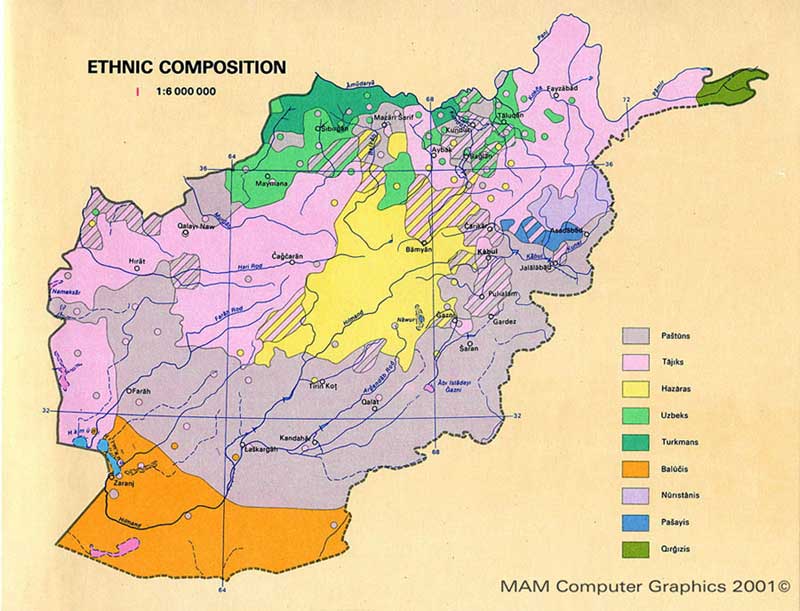 |
| Afghanistan has a large number of diverse ethnic groups |
Another problem that could return to the surface is ethnic
discrimination. Northern Afghanistan is home to a wide variety of
ethnic groups, including Uzbeks, Turkmens, Tajiks, Hazaras and Pashtuns. As
coalition troops leave, there could be increased scope for ethnic disputes,
especially if they are fuelled by the relevant neighbouring countries, which so
often get involved in Afghanistan’s internal affairs (Uzebekistan has close
ties to the Uzbeks, the Iranians support the Hazaras etc.) The Minority
Rights Group International already reports increasing ethnic tensions
between Hazaras and the nomadic Kuchis travelling over their land. Relations
between Pashtuns and the other ethnicities in the north have often been
extremely difficult. Massacres which occurred during the Afghan Civil War (such as the killing of
Hazaras in Mazar e Sharif by Taliban forces) are not easily forgotten. There
have been reports since the
American invasion of ethnic discrimination and violence. In Ignatieff’s book
‘Empire Lite’, he highlights how often in Afghanistan, disputes between Afghans
are resolved because of the American man sitting in the corner of the room.
Everyone knows that if they violate an agreement or go back on their word that
American man can call in the vast airpower of the United States as a punishment.
The problem is that when the Americans leave, what will ensure that violence
and discrimination between different groups in Afghanistan does not re-emerge?
Wednesday, 23 May 2012
A strategic snub, and a fall-guy

Pakistan's President Zardari was snubbed. He should have been meeting
President Obama at the G8 summit in Chicago to discuss the reopening of the
NATO supply route through Pakistan into Afghanistan. Instead Obama was too
‘busy’ to meet with Zardari, leaving him to be attended to by US secretary of
state, Hilary Clinton.
How times have changed between the two nations. Under Bush,
Pakistan was cajoled and caressed with $billions in foreign aid for their part
in assisting the ‘war on terror’. Over time, relations have deteriorated to an agitating
extent as the role of certain hands within Pakistan has left the US frustrated
and angry. Finding Osama Bin Laden hiding away in a safe haven a few miles from
a military compound hasn’t helped, neither have the 2008 attacks by Lashkar-e-Taiba
on Mumbai, nor finding Ilyas Kashmiri – one of the top al-Qaeda commanders – in
South Waziristan. President Karzai had always insisted that the real insurgency
was coming from Pakistan; the US now believes him slightly more than before.
Inversely, Pakistan is frustrated and angry at the US –
angry for their covert Bin Laden operation, angry for the continuous use of
drone strikes that kill innocent civilians, and angry for the Americans
implying a link between the state, the security services and various terrorist
groups. Pakistanis feel frustrated, perhaps rightly so, that they have suffered
from terrorism a lot more than the international community is willing to
recognise.
The latest in frustrations between the two countries
surrounds disagreement over the NATO supply routes. The supply route was closed
following furious backlash to US drone attacks in November last year which killed
26 Pakistani soldiers along the Afghan border. NATO has had to move the supply
route to the north of Afghanistan, costing them more time and money.
Discussions to reopen the route looked potentially fruitful earlier last month,
as the Deputy Secretary of State, Thomas Nides, travelled to Islamabad to eke
out a new agreement. However, the Pakistan Parliament and the religious right
guaranteed that the reopening would face resistance.
Pakistan wants to increase the transit charges from $250 to
as much as $2000. The US has responded by threatening to freeze the $655m in payments
to the Coalition Support Fund until Pakistan reopens the routes. The US clearly
has had enough.
But Zardari is stuck between a tough rock and a very hard
place. He does not want to concede the supply routes to NATO without a fight,
especially considering the ever growing opposition to drone attacks within
Pakistan. His party, the Pakistan People’s Party, has lost substantial support
inside the country amidst continuing allegations of corruption, ineptitude, a
crumbling economy, and worsening security. Zardari is almost likely to lose.
However, the crumbling economy needs investment and US aid
is a major part of that. Zardari also does not want to isolate Pakistan;
political and diplomatic isolation means a weak bargaining power apropos
Afghanistan. The US and Afghanistan have already laid out a post-2014 plan
which includes stipulations such as American use of Afghan military bases should
any ‘interference’ occur. Interference occurs in Afghanistan on a daily basis
of course, through the porous border with Pakistan. In defence of the Pakistani
army a bloody battle has been fought in the lawless North-Western Frontier
Province (NWFP), and some headway has been made on security in the region, but much
to the cost of many lives. The Pakistan forces have lost over 3,000 personnel
since the war on the extremist groups in the NWFP started in 2005.
Even worse for Zardari is Afghanistan’s strong relationship
with India; late last year Karzai travelled to New Delhi to formalise a
strategic deal that would allow arms transfers, military training and direct foreign
investment from India. This is not to mention the huge $billion deals already
in place for Indian companies to mine minerals and iron ore in Afghanistan.
Pakistan must feel squashed as India squeezes pressure from both sides. This is
probably the reason why Pakistan finally afforded India a ‘Most Favoured Nation’
status; it needs to reopen trade with its neighbour in order to survive.
But this is all just a diplomatic chess game. From the
American side, the Obama administration would not want an isolated Pakistan;
isolation will leave Pakistan with a crippling social-economic fabric that is
dangerous for the region. True that much of the terrorism inside Pakistan has
been in reaction to the US presence in the region, but the Kashmiri issue and rampaging
corruption has allowed extremist groups to create instability.
From the Afghan side, the real problem is likely to occur
after NATO troops begin pulling out; the Afghan army and police forces will be
severely tested as insurgents pour in from the lawless Khyber Pakhtunkhwa. Much
will depend on whether the Taliban can be integrated politically. If they can, then
Pakistan may once again become an ally. If they cannot, then the insurgency is
likely to intensify.
Obama’s snub on Zardari was probably done with all these
factors in mind, aside from just personal annoyance. Zardari will be indebted
for the invitation to the NATO summit and humiliated at the snub; it will leave
him with little bargaining power. Concessions will be made on the supply routes
for the guarantee of US aid, and someone will be fall-guy for the unpopular
decision. Chances are it could well be Zardari himself.
Friday, 4 May 2012
The future for Afghanistan looks increasingly bleak

President Hamid Karzai’s government is weak, and regarded as untrustworthy and corrupt by the Afghan people and their neighbours. The people of Afghanistan cannot identify with the current government; increasingly the Taliban have more control over the country outside of urban centres. The scope of the Taliban’s influence is only going to spread further as the NATO troops withdraw; despite the rhetoric from the various coalition armed forces, the Afghan Security Forces are nowhere near ready to take over policing the country.
Reports leaked to the BBC suggested that many Afghan people prefer the Taliban to the Western forces and the Afghan authorities. The Taliban have more presence across the country than the American led coalition and are seen as less corrupt than the Afghan authorities. For a largely illiterate and deeply religious populace, the swift harsh justice the Taliban provide is preferable to the inconsistent, poorly administered rule that Karzai’s government offers. In addition the Taliban are increasingly organised, and more responsive than the central government. The Taliban officials make regular visits to small towns and villages, and even administer a system of taxation, justice and social support to areas they control.
Sources inside the country told the NCF of their concern for the future of Afghanistan. They highlight the failure of the Afghan security services to provide stability to the country as their chief reason to worry. There is the principle fear of the spread of the Taliban’s influence across the country but also of a failure of the intelligence services to prevent attacks from insurgents.
Leaked security reports detail that security services in Afghanistan had prior warning of many of the attacks that took place during April this year. The documents give details of who the Taliban planned to attack as well the locations that they targeted. These oversights are often put down to ‘intelligence failures’; principally because the sources informing the intelligence services are not properly assessed and verified, and the warnings are ignored.
Furthermore our sources stressed the problems they faced as investors in Afghanistan. The withdrawal of American troops also means a withdrawal of American funding, and with that comes a large drop off in foreign investment, scared that the country may disintegrate into a state of civil war. This means that Afghanistan’s small, fragile economy is certain to falter. Additionally, beyond the dangers of attacks from insurgent groups, the sheer weight of corporate bureaucracy and institutional corruption paralyzes progress.
All in all the future for Afghanistan beyond 2014 is bleak. The Taliban’s influence across the country spreads, and Karzai’s unpopular government looks unsustainable without backing from NATO. The Strategic Partnership Agreement brings a modicum of stability to the country short term, but in reality it is little more than a means of covering the West’s strategic withdrawal from Afghanistan. For those who hoped the Afghanistan could be a progressive integrated nation, these are dark times indeed.
T. J. Callingham
Subscribe to:
Posts (Atom)