
Monday, 1 January 2024
With Hope for a Better New Year


Wednesday, 15 April 2015
Drawings from ‘a side of Afghanistan we rarely see’
Journalist and reportage illustrator George Butler travelled to Afghanistan in late 2014 – in the midst of British and international troop withdrawal after their thirteen years long presence. George drew everyday life in villages and cities across the country, offering a compelling insight into a country living with conflict. In 2013, the Next Century Foundation (NCF) and the International Communications Forum (ICF)awarded George with the International Media Awards for his drawings of the Syrian refugee crisis in Lebanon. The International Media Awards, which began in 2004, is an annual award ceremony held in London that acknowledges journalists who work in and on the Middle East and North Africa.
 Faizabad Market
‘Day to day life seems to continue at the Faizabad market as any market might. People pour out of the mosque on the other side of the street in this north eastern Afghan city. One man sells a partridge in a wicker cage, another any bathroom product you could ever imagine. There is also the mobile phone credit man and the fruit seller’s cheeky son.’
In Kabul
George describes: ‘Life in Kabul over the last 30 years has not been easy by any stretch of an outsider’s imagination. At the end of 2014, international combat troops were set to have drawn down from Afghanistan. However, in reality there is still an international military presence. With regular explosions targeted at the prominent places in the Kabul the local and Military Police spend much more of their time at checkpoints. It is a particularly vulnerable time for them. It is not though the aggressive unfriendly place you might imagine from the news.’
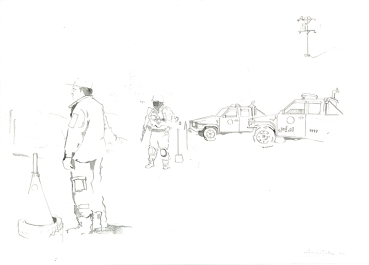
Checkpoint
‘I had been given permission by the Chief of Police of Kabul’s District 10 to draw at one of their checkpoints. These have become commonplace due to the heightened security risk. With this in the back of my mind I drew quickly and this was all I finished before deciding it was time to leave. Westerners and the police force were high up on the list of targets and the two together would have at some stage attracted unwanted attention.’
George’s drawings are exhibited in the Imperial War Museum North in Manchester from 21st February until 6th September 2015.
Wednesday, 8 April 2015
Mullah Omar’s Re-emergence
The Taliban have published a biography of their leader,
Mullah Omar, who has spent a decade in hiding, stating that he is alive and
remains in touch with the current events and political developments in Afghanistan.
Mullah Omar has not appeared in public since the American-led invasion of
Afghanistan in 2001.
But, why did Mullah Omar feel the need to address the
rumours about his serious illness or death?
The release of Omar’s accounts could either be a sign of the Taliban’s regained strength following the withdrawal of foreign troops from the country or – perhaps more likely – a reaction to defections from within and an attempt to reunite the increasingly scattered and demoralised group. With the growing influence of Islamic State (IS) in Afghanistan many disgruntled commanders are believed to have withdrawn support and pledged allegiance with IS leader Abu Bakr al-Baghdadi. So with the re-emergence of Mullah Omar, the Taliban hope to reinstate their power and boost fighters’ morale.
The release of Omar’s accounts could either be a sign of the Taliban’s regained strength following the withdrawal of foreign troops from the country or – perhaps more likely – a reaction to defections from within and an attempt to reunite the increasingly scattered and demoralised group. With the growing influence of Islamic State (IS) in Afghanistan many disgruntled commanders are believed to have withdrawn support and pledged allegiance with IS leader Abu Bakr al-Baghdadi. So with the re-emergence of Mullah Omar, the Taliban hope to reinstate their power and boost fighters’ morale.
Sunday, 5 April 2015
Afghan women call for action
19th MARCH 2015: The violent murder of the 27-year old Farkhunda Malikzada led hundreds of people in Afghanistan to go out on the streets, protest for women’s rights and call on the authorities to enforce law and justice. Farkhunda was beaten to death by a crowd of people in front of a mosque witnessed by local police officers, who did nothing to stop the crime. The mullah accused her of burning pages from Quran. Police investigations later revealed that these allegations of Quran desecration were false and she had merely criticised the mullah’spractice of selling charms at the Shah-Do Shamshira Mosque, a religious shrine in Kabul. Afghan diaspora communities in the United States and Europe expressed their solidarity demanding ‘Humanity before Religion’. Their message is clear – punishment must come from courts and an independent jurisdiction, instead of from religion and tradition. 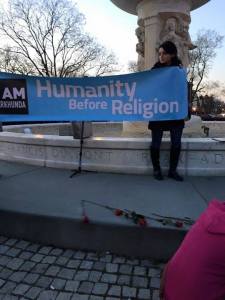
Zohra Mahmoud Ghazi, herself an Afghan woman living in London, expresses her anger over Fakhunda’s vicious death and her admiration for the many brave women that raised their voices and joined in protest: ‘The burial of Farkhunda was carried out solely by women – an unprecedented practise in Afghanistan showing their anger and revolt against both the perpetrators and the general gender inequality. What I found most disappointing, although the two main leaders [President Ashraf Ghani and CEO Abdullah Abdullah] were in the United States at the time of the incident, that we still have not seen either of them facing the Afghan public at the street level and sharing the public’s pain.
‘The President has ordered a commission to investigate the killing and that is good. However, I would like to see him and Abdullah Abdullah joining the protesters on the street and show their solidarity with the people and genuine understanding of the hurt that many feel about what has happened. The killing has awoken many raw feelings within Afghan women. The government needs to clearly position themselves on the side of the people who call for women’s rights, humanity and a fair justice system. It is important that these voices are heard and their anger is translated into change on a political level.
‘As many Afghans living abroad, I have the luxury to say a lot more than I would be able to if I was still in Afghanistan. However, I believe that it is important not to forget the terrible incident. Fakhunda’s pain should not be in vain. March 19thshould become a day of commemoration, an Afghan women’s day, when people remember not only her death, but also the hardships of women in Afghanistan in general and ways of strengthening their voices and implementing their rights. I want something to change after the killing and the outrage it caused both in Afghanistan and abroad. It should not be brushed under the carpet, but used as a wake up call for action. Strong societies depend on gender equality and women’s empowerment.’
Thursday, 19 March 2015
Bennett on Afghanistan
Well, if you want a contrary view from an old soldier who has served in Afghanistan and knows the ropes you could do no better than listen to Charles Bennett, Head of the European Atlantic Group. His perspective may disturb you however:
Follow this link to see the broadcast
Follow this link to see the broadcast
Friday, 13 March 2015
Promising Steps towards Peace?
In an attempt to foster peace in the region, Afghanistan’s President
Ashraf Ghani pursues a strategy of dialogue and reconciliation with Pakistan,
Afghanistan’s Eastern neighbour and the Taliban’s erstwhile backer. With
Pakistan and China offering their support, latest peace initiatives appear more
promising than recent attempts. There are signs of cooperation and improving
relations between Afghanistan and Pakistan as the Pakistani government
threatened to arrest or expel Taliban leaders, in case they refuse to negotiate
with the Afghan government. In return, Afghanistan has made ‘a string of once
unthinkable concessions to Pakistan’ (Guardian, 10.03.2015) and targeted
strongholds of the Pakistani Taliban (TTP) in its eastern provinces
neighbouring Pakistan.
However promising developments appear, scepticism about the prospects
for peace remains. One major obstacle is the internal rift within the Taliban,
which informs the commonly used differentiation between the Taliban as a whole
and the so-called ‘reconcilable elements of the Taliban’. Hence, while political
leader Akhtar Mohammad Mansour is in favour of engagement, commander Abdul
Qayum Zakir, who used to be detained in Guantanamo and holds sway over several
thousand fighters in eastern Afghanistan, opposes negotiations. According to
Reuters, attempts of Mansour to overcome differences with his opponent and
convince him to join the negotiating table failed as Zakir believes that only
the United States hold real power in the region and negotiations with the
Afghan government will be irrelevant.
A further obstacle threatens to delay peace talks – the irreconcilable
demands of the Taliban in return for negotiations. In a recent interview, one
of Ghani’s aides presumes that the Taliban will not only demand an immediate
departure of foreign troops from Afghanistan but also a re-imposing of the
harsh interpretation of Islamic law, the movement had enforced during its rule.
These demands would be unacceptable for the Afghan government and hence pose
the threat of another diplomatic deadlock. The upcoming weeks and months will
be crucial for Afghanistan, Pakistan and the future stability of the entire
region. One can only hope that Ghani’s attempts succeed and the Taliban will
join the government at the negotiating table.
Thursday, 26 February 2015
ISIS’ Threat in Afghanistan
As NATO coalition troops depart from
Afghanistan, there are growing numbers of violent attacks from groups claiming
allegiance to ISIS. Daesh affiliates are supposed to be operating in the
provinces of Ghazni, Helmand, Farah, Zabul, Faryab, Parwan and Logar. The
threat is further enhanced by ISIS’ activities in Afghanistan’s eastern neighbour Pakistan.
Despite the question whether ISIS poses an actual further threat to Afghanistan and whether it is substantially different from the Taliban, the fear over ISIS’ activity in Afghanistan will be an important factor for the West to reconsider its efforts and policies towards the country. The issue might serve as a wake-up call for the international community that needs to adjust its narrative of ‘all is going well in Afghanistan’ and ensure a longer-term development strategy in order to avoid the further deterioration of the country.
Subscribe to:
Posts (Atom)